

Your kid stops dead in the middle of Target, points at a LEGO set the size of a microwave, and announces, "I'm saving up for that." Or the campaign starts online, from the kitchen table, while you're unloading groceries. Annoyingly, this is a good math lesson, which means you have to respond like a calm adult instead of saying "absolutely not, keep walking."
Pick a goal they can actually see the end of
A first savings goal needs a finish line your child can picture. Not "money for college." Not "for later." Later is fog to an 8-year-old. Most elementary kids need a thing: a basketball hoop, headphones, a model kit, the water bottle they suddenly believe will change their life.
Aim for something they can reach in about 3 to 8 weeks at their normal allowance or earning rate. Long enough to feel like saving, short enough that the chart doesn't turn into background furniture. Do the math out loud. A $3-a-week kid who wants a $200 item is looking at 67 weeks.
Sixty-seven weeks is not a first savings goal. That's a retirement plan with stickers.
If the goal is too big, negotiate before anything gets taped to the fridge: a smaller version, a used one, or a chunk you cover up front. "I'll pay $25, you save the other $20" is clean. "We'll see" is where family budgets go to die. If your kid doesn't have a regular allowance yet, an allowance system that survives past week one is the place to start, because saving is hard to practice with money that shows up at random.
Print a picture of the item and tape it above the chart. Kids do better when the goal is visible. Adults too; there's a reason my grocery list says COFFEE in capital letters.
The chart on the fridge
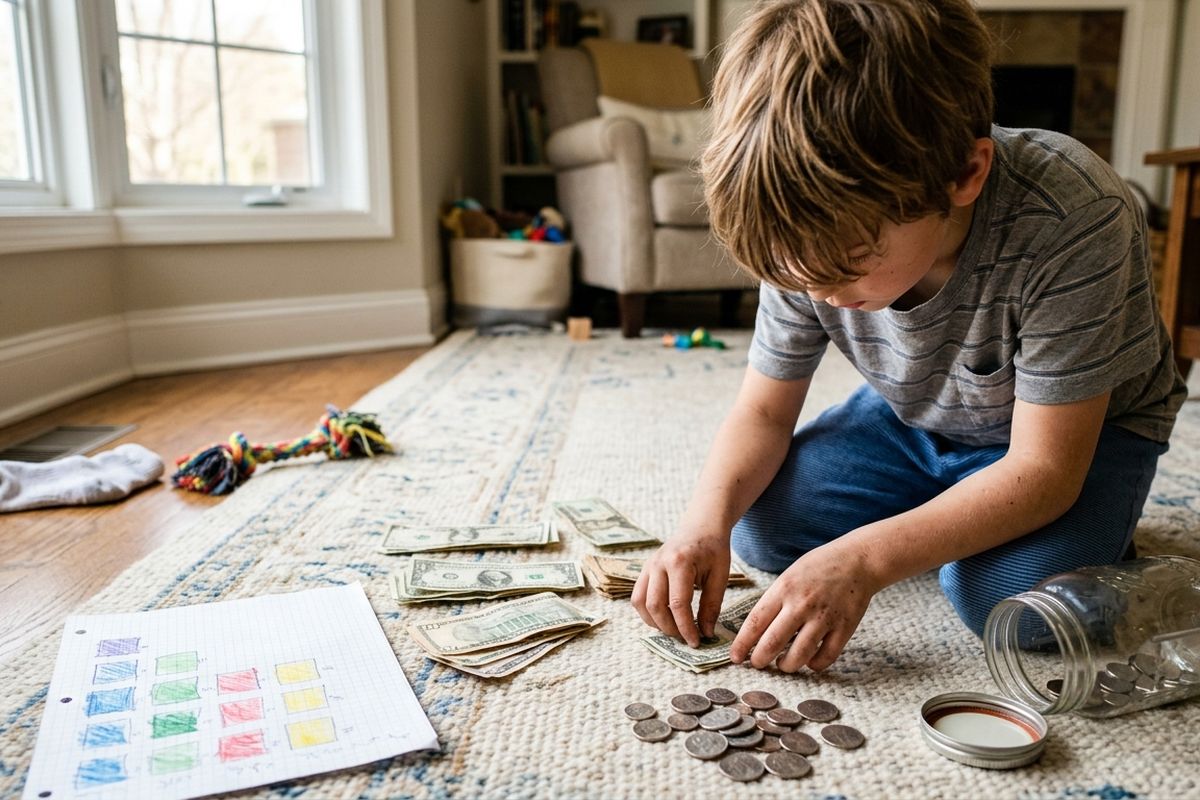
Make the chart boring and clear. A hand-drawn thermometer works, so does a row of boxes. If the goal costs $30, draw 30 boxes, one dollar each. If your child gets paid weekly, each box can be a week instead. The point is that they can glance at it while reaching for string cheese and see progress.
Color it in the moment money arrives. Not "sometime this week," not at bedtime when everyone is cranky. Allowance goes in, box gets colored.
At my kitchen table the rule is that the cash stays visible. A clear jar is best. A labeled envelope works if you have a child who treats loose bills like confetti. A bank app is fine for older kids, but for a first goal it hides the lesson; numbers on a screen don't feel like three crumpled dollar bills and seven quarters.
This is where the math sneaks in without a worksheet stapled to it. They add ("I had $12 and got $4"). They subtract ("it costs $35 and I have $16"). They ask the useful question: how many more? Somewhere in there they start multiplying, too. "If I get $5 a week, how many weeks till $25?" beats any word problem about Lena and her 43 melons, because somebody in your house actually wants the answer.
The halfway wobble
Somewhere around 40 to 60 percent, almost every kid wobbles.
They have $18 toward a $35 goal, and suddenly the dollar section looks like a land of opportunity. Slime. A notebook with a lock that will break by Thursday. This is normal. It's also the moment you'll be tempted to give a speech about perseverance.
Resist. I say this as a parent who has absolutely given the speech and watched it float up into the ceiling fan.
Name what's happening: "You're halfway, and waiting feels boring now." Then redo the math out loud, voice plain. "You have $18. The scooter is $35. You need $17 more. Five this Friday, five next Friday, five the Friday after, and you're at $33." Three weeks feels different when you can point at three actual Fridays.
Then offer to revisit the goal. Not rescue, revisit. "You can keep saving for the scooter, or decide you want the small thing more. If you buy the small thing, the chart changes." If the money is truly theirs, let them choose. A savings goal is practice, not a moral contract, and some kids need to abandon one goal to find out what a trade-off feels like.
The one thing to settle before this moment, not during it: the robbing-the-jar rule. Is goal money locked, or can they change their mind? Either works. What doesn't work is inventing the rule while your child is holding a $6 squishy in aisle nine and you're late for soccer. At our house, savings jars are flexible but come with a 24-hour wait before anything comes out. It doesn't always help. It usually helps.
Matching, extra jobs, and why not to buy it at 80 percent
You can match savings. You don't have to. Matching is a tool, not a law.
If you do, keep it simple and agree in advance: 25 cents on the dollar, or a one-time bonus at the halfway mark. "When you hit $20, I add $5." That's a boost without turning the whole thing into a parent-funded shopping trip wearing a fake mustache.
Extra jobs speed things up too. Extra, not regular. In most families, clearing your plate and feeding the dog are just part of living in the house (where that line sits is its own topic, and kids and chores during the school year gets into it). Paid extras might be wiping baseboards, pulling weeds for twenty minutes, or matching the lonely socks, which is somehow a permanent position. Birthday money counts if they want it to. Just ask before it goes in the jar: all of it, or part?
The part I wouldn't skip is the last stretch. When your child hits 80 percent and you quietly buy the thing, you've removed the hardest and best piece. The final $6 is where they learn that close isn't done.
I know. The paper is curling and someone dripped yogurt on the corner. Let them finish anyway.
The exception is a sale that ends today. Cover the difference if you want, but say exactly what happened: "It's $8 off today, so I'm covering the last $4 because you did the saving." No mystery money.
The day they buy it
Let them pay.
Yes, it takes longer. Yes, the cashier may have to count damp dollar bills that have been living next to the bananas. The whole point was to connect the saving to the buying.
Warn them about tax before you go. A $29.99 item is not $29.99 at the register in most states, and sales tax is one of those real-world math facts adults forget to mention until a kid is standing there with exact change and betrayal in their eyes. Either build tax into the goal from the start ("about $33" is a good kind of estimate for a 3rd or 4th grader) or announce that you'll cover tax on the first big purchase. Say it out loud either way. If your child is still shaky on coins and change, money math at the store walks through the register moment in more detail.
Have them count the money out. Have them take the change. Pause outside the store and look at it together: "You paid $35, it was $32.48, you got $2.52 back." Subtraction under fluorescent lights, with a receipt. More memorable than a worksheet about backpacks.
The thing may disappoint them in two weeks. That's a lesson too. Maybe it's flimsier than the box promised, maybe the wish was better as a wish. Don't say "told you so," even if you did, with the accuracy of a weather service. "You worked for it, and now you know more about what you like buying" is enough.
What sticks isn't "waiting is good." Waiting is often just annoying. What sticks is more specific: money grows in weeks, choices have trade-offs, and "how much more?" turns into a habit. The second goal is nearly always easier, because your kid now has proof that a row of little boxes can turn into an actual thing in their hands.


