

A worksheet comes home with three careful sentences about fall and disappears under the granola-bar wrappers in the backpack. A letter to Grandpa gets taped to a refrigerator two states away, next to the grocery list and the school photo with the crooked bangs. Kids can feel that difference. Writing for nobody and writing for someone who will squint at it, smile, and call to say "I got your note" are two different jobs, and only one of them teaches much.
Why a real reader changes everything
In my classroom I could tell within a sentence whether the writing had a real audience. "Write three sentences about fall" produced, reliably: "I like fall. Fall is fun. I like leaves." Fair enough. But a note to the principal about the puddle by the slide? Suddenly we had details. We had opinions. We had punctuation with a purpose.
Kids write more, and usually better, when the words are going somewhere. A real reader gives the writing a job. It stops being handwriting practice and becomes news ("I got new shoes and they are fast"), a question ("do you still have that dog?"), a joke, or a small "I miss you." That's the whole heart of early writing right there. The same thing is true of thank-you notes, which are basically this article in miniature.
Grandparents happen to be the perfect audience. They're forgiving. They enjoy the details the adults in the house have stopped hearing by Thursday. They will read, reread, and preserve a sentence about a loose tooth like it's a historical document. And they write back, which nobody does for a worksheet.
Pre-K to kindergarten: a drawing and one line
At this age a letter doesn't need to look like a letter. Think refrigerator masterpiece with a caption.
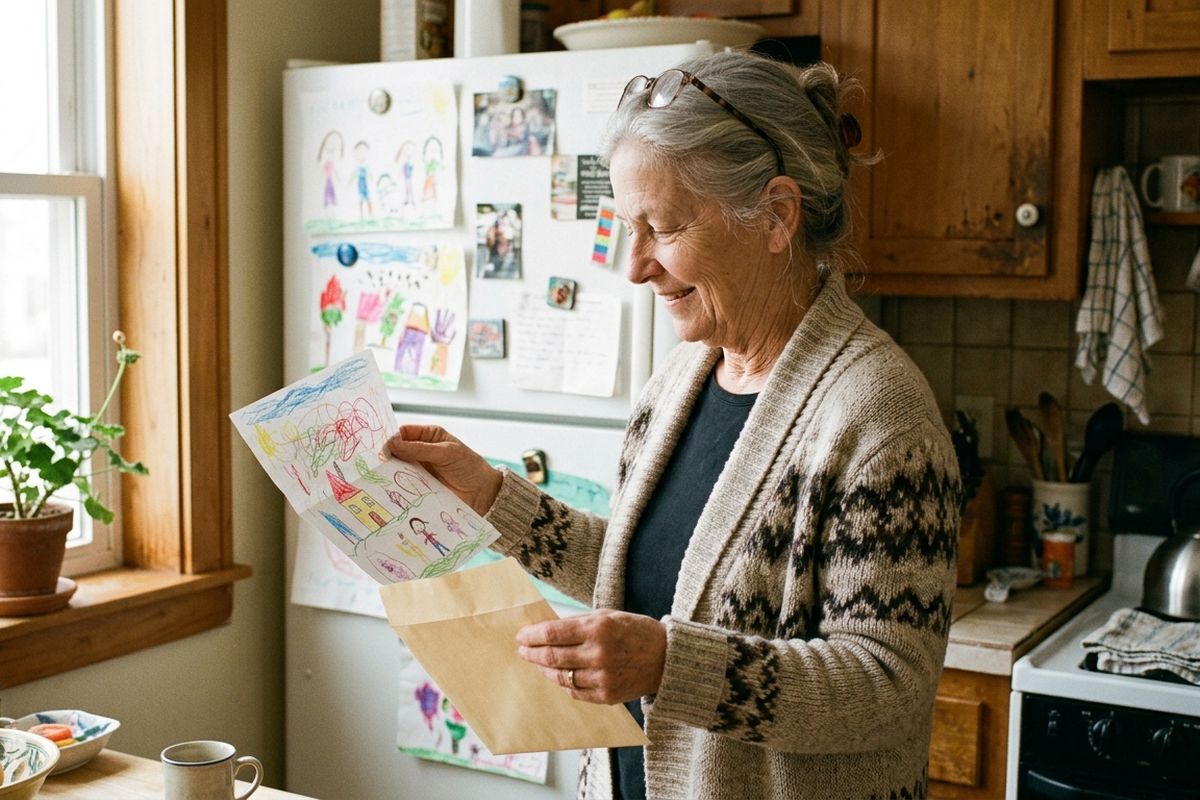
Your child draws first. Nana's cat, a rainbow, a volcano, one very large person with hands growing out of their ears. Then you ask, "What should I write under it?" and write exactly what they say, or help them copy one short sentence. "I ate pancakes." "My tooth is wiggly." "I love you." One line is the whole assignment.
Scribble-writing counts. If your child makes loops and lines and announces "this says I miss Papa," treat it as writing, because that's what it is. Add a small translation underneath if you like, but don't let the grown-up version take over the page. There's a nice picture of what those early marks mean in early writing, from scribbles to sentences.
The envelope is half the lesson. Let your child fold the paper (badly), slide it in, lick the flap, stick the stamp on crooked and carry it to the mailbox. To a five-year-old, the mailbox is a little bit magic. Honestly, same for some of us adults.
1st and 2nd grade: postcards and three-sentence letters
First and 2nd graders can handle a bit of structure, but not the full "friendly letter" lesson with six labeled parts and everyone sighing. A postcard is perfect because it's small. The tiny space says, kindly, you do not have to write a chapter.
A postcard can come from a trip, sure, but it can also come from the kitchen table. A blank index card works. A photo from last weekend with the back written on works. A store-bought postcard of your own town is fine even if your child has never left the county.
Give them a three-sentence formula: one piece of news ("I got to be line leader"), one question ("what did you eat for breakfast?"), one sign-off. That's enough. Truly.
Invented spelling stays. If your child writes "I likt the big sno," Grandma will understand, and if she doesn't she can call and ask, which is the best possible outcome. When she reads the postcard back aloud on the phone, your child hears their own writing come home as real communication. If you're wondering whether that spelling is normal for the grade, invented spelling is progress is the calm version of the answer.
3rd grade and up: emails, video messages, and the longer letter
By 3rd grade many kids are ready for email, especially with you nearby for the first few. Typing takes the hand fatigue out of it, and the reply chain turns into sneaky reading practice: they read what Grandpa wrote, answer one part, and the thread keeps going.
Keep it simple. Teach a subject line that actually says something ("My soccer game," "Question about your dog," "We made soup"). Then one paragraph about one thing. Not their whole life since September. One thing.
"Hi Nana, we had a fire drill today and it was very loud. My class had to stand by the fence. Did you have fire drills when you were in school? Love, Ben." That's a complete, excellent email.
For the kid who freezes at the blank screen, try a voice memo or a short video first. Let them tell the story out loud, then add one written line to go with it: "This is the Lego tower I told you about." That one line still counts as writing, and for a kid who hates writing, it's often the line that gets the door open.
Longer letters come later, and they come easier when writing to family has been normal for months. A full page is much less scary when it's just a bigger version of something you already do.
Don't edit the charm out
This is the hardest part for grown-ups. We see the missing capitals. We see "grampa." We see "I lost a toof" and our correcting hand twitches.
Let it ship.
A letter to a grandparent is not a spelling test. If your child asks how to spell something, answer. If a sentence is truly unreadable, say "read it to me so I can make sure Grandma gets the whole story" and add a tiny parent note underneath. But the kid's version stays the star.
What to fix: names, mostly. "Grandma's name has a d in it, let's put it in so the mail carrier knows." The address, because mail carriers are patient but not fairy godmothers. What can wait: almost everything else. "dear grandpa i lost a toof" has a heartbeat. It sounds like your child right now, in this exact little season, with the gap in their smile and the big news in their pocket. Fix it and you've written a different letter.
The grandparent's job is simple: write back, and ask one question. A sticky note in an envelope is plenty. "Did the tooth fairy come?" "What color are the fast shoes?" "Can you draw me the volcano?" That question is the reason your child writes again.
Making it a monthly ritual that survives October
The trick is to make grandparent mail ordinary. Not a holiday project, not a guilt cloud. A small monthly thing that lives in the rhythm of your house.
Pick a moment that already has a shape: first Sunday of the month after breakfast, the day you flip the calendar, the first rainy afternoon. Keep a basket somewhere reachable with stamps, envelopes, a few postcards and blank cards, and pens that mostly work. Mostly is fine. There's always one marker without a cap.
Then keep a running list on the fridge, "Things to Tell Nana," and add to it all month: lost tooth, saw a hawk by the soccer field, made banana bread, learned to snap, the dog ate one mitten. When your child says "I have nothing to say," point at the list. If the list is empty, use the three-part prompt: one thing you did, one thing you ate, one thing you wonder. That covers a surprising amount of childhood.
Set the bar low enough that you'll actually keep it. One drawing. One postcard. One email with two sentences. Address it, stamp it, and get it to the mailbox before the day gets swallowed by laundry, cleats, and someone needing help finding the blue cup.


