

"Is midnight a.m. or p.m.?" my youngest asked, already suspicious that the answer would be unfair.
It is a little unfair. Time words are full of small traps, and then a worksheet asks a child to write "quarter to six" under 5:45 as if English had done them any favors. At my kitchen table I start with the clock we actually live by: dinner at 6:00, bed at 8:30, and the car leaving in ten minutes whether or not both shoes have been located.
A.M. and P.M. (and the two hours that break the rule)
Most kids first learn a.m. and p.m. as "morning" and "afternoon." That works fine for a while. Breakfast is 7:00 a.m., soccer is 4:00 p.m., done.
Then 12 shows up and wrecks the system.
The clean version: 12:00 p.m. is noon, and 12:00 a.m. is midnight. Noon goes with lunch. Midnight goes with being asleep. Kids find this backwards because they expect 12 to be the end of something. They watch 11:59 a.m. flip to 12:00 and it is suddenly p.m., with no warning. There's no logic they can feel there. It's a naming convention, and naming conventions are where math and language shake hands badly.
I skip the Latin with elementary kids unless they ask, and they don't. What sticks is real sentences: "We eat lunch at 12:00 p.m." and "You were asleep at 12:00 a.m." Kids remember sandwiches and sleep better than abbreviations. If your child wants a picture, draw a big circle for the whole day, put midnight at the top and noon at the bottom, and shade the two halves. Not a science diagram. Better than another page of "circle a.m. or p.m." with no context, though.
"Quarter past" vs "quarter to": the direction words
Quarter past and quarter to aren't hard because of the word quarter. Most 2nd graders can learn that a quarter of an hour is 15 minutes. The hard part is direction.
Past means the hour already happened. To means the next hour is on its way. So quarter past four is 4:15: four o'clock came and went, and 15 minutes have gone by. Quarter to four is 3:45. Four hasn't happened yet. It's 15 minutes off.
That 3:45 is the one that makes kids glare at adults. They hear "four," the digital clock says 3, and it feels like a trick question. Honestly, it is a little bit.
Here's the trick nobody tells you: for the first half hour we talk about the hour we're in (ten past four, quarter past four, half past four), and after the half we start leaning toward the next one (quarter to five, ten to five). Not everyone talks this way, especially in the US, where plenty of us just say "four forty-five." That's fine. But your kid will still meet "quarter to" in chapter books, on 2nd- and 3rd-grade math tests, and from the receptionist who says "come back at ten till." If you're wondering when all of this is supposed to click, most kids get there in a wide window, and the timeline for telling time is longer than most parents expect.
"Half an hour" vs "half past" vs "in an hour"
The word half gets three different jobs, because apparently one was too easy.
Half past is a spot on the clock: half past seven means 7:30. Half an hour is a length of time: 30 minutes, starting whenever. "In an hour" is also a length, but it starts right now. If it's 2:17 and I say we leave in an hour, we leave at 3:17. Not at 1:00. Not when the clock has a 1 on it.
That last one trips up more kids than you'd think. They hear "an hour," go looking for a one, and come back confused and slightly betrayed. Sensible, and wrong.
The kitchen timer helps because it turns time into something you can watch shrink. "Screens off in half an hour" becomes a 30-minute timer on the counter, plus one label: "Half an hour means 30 minutes from now." Not a lecture. Just the label.
The car is good too, because nobody can leave. If the GPS says 18 minutes, say "that's less than half an hour." If you pull out of the dentist's lot at 3:20 and home is ten minutes away, say "we'll be home at 3:30, half past three." My own 4th grader has absorbed more time vocabulary from the back seat than from any worksheet, and I say that as someone who has seen some truly heroic worksheets. Once "in an hour" makes sense, the elapsed-time problems that show up in 3rd grade get a lot less scary.
Digital kids, analog words
A child who grows up looking at a phone clock will say "three forty-five," and they're right. Digital time is clear and efficient and, frankly, less dramatic.
Analog vocabulary is older and fussier. It comes from looking at hands on a clock face and seeing chunks: half the circle, a quarter of the circle, five-minute hops. A kid who only ever sees 3:45 doesn't automatically see "15 minutes until 4." They see a three, a colon, a four and a five.
And the fussy words still wander around real life. School schedules ("lunch is at half past eleven"), grandparents ("we'll call at quarter till"), the doctor's office ("be here ten minutes before"). And the clock face on a 2nd-grade test, where your child is supposed to know the minute hand on the 9 means :45.
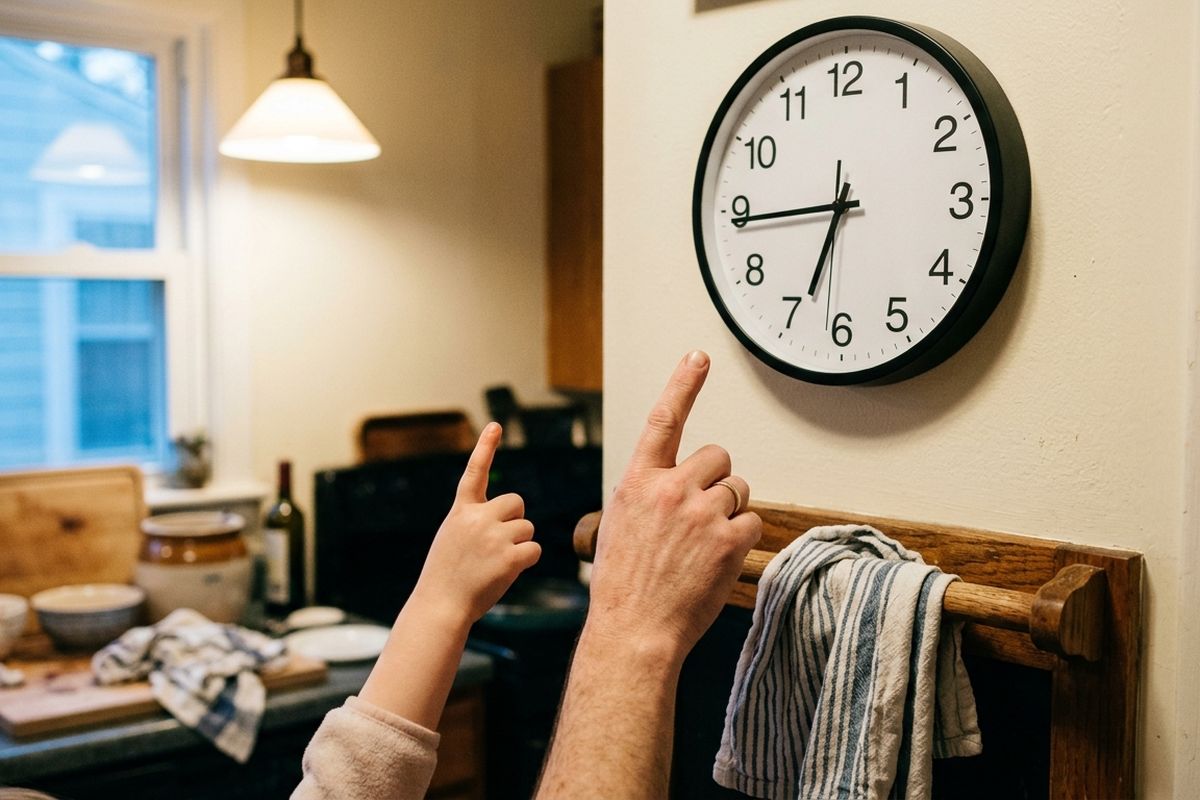
So I like one analog clock in the house. Not a stylish one with no numbers, charming as those are. A plain clock with numbers and hands, in the kitchen, where time gets bossy: lunch boxes, dinner, the timer beeping while someone yells that the blue hoodie is gone. Digital tells the exact time. Analog lets kids see time moving. They need both.
A week of saying the time out loud
This does not need to become a project. Please don't print seven pages unless that brings you peace. A week of saying the time out loud at moments that already exist does more than a stack of blank clock faces, because your child hears the words when the words matter.
- Monday, o'clock. "It's 7 o'clock, shoes on." Keep it boring.
- Tuesday, half past. "It's half past seven, so 7:30." Say both, the phrase and the digital translation.
- Wednesday, quarter past. "Quarter past five. That's 5:15." Point at the clock, or the microwave. We're not fancy here.
- Thursday, quarter to. The sticky one. "Quarter to eight, so 7:45. Eight is coming." Expect an argument that it says seven.
- Friday, in ten minutes / in an hour. Always give the end time too: "It's 4:05, so in an hour is 5:05."
Saturday, let your child catch you. Say "it's quarter past six, right?" when it's 6:45 and wait. Kids who resist practice will leap at the chance to correct a parent. Use this power.
Sunday, mix the two languages in one sentence: "It's 8:30, half past eight, and bed is at 9." Then stop. One sentence is plenty. The goal is for time words to feel as ordinary as "before dinner" and "after school," which is also why the practice that works is the kind nobody notices is practice.


