

"How many sleeps until Grandma comes?" arrives from the back seat for the fourth time, usually while you're merging, mentally answering a work text, and wondering whether anybody ate the lunch you packed.
The real answer is six. The better answer is "let's check the calendar when we get home," and not because the calendar is magic. Time is genuinely slippery at this age, and a square on the wall beats another explanation shouted from the front seat.
"How many sleeps" is the only honest unit they have
Young kids don't measure time in numbers yet. They measure it in events: sleeps, school days, weekends, after swim, when Dad gets home, after the big trash truck comes. A week isn't a length to them. It's a word adults say while pointing at a rectangle full of tiny numbers.
"Thursday" means almost nothing until it has a job attached. Thursday is library day. Friday is pizza night. Tuesday is the day the recycling has to reach the curb before seven, ideally carried by someone wearing shoes.
So when your child asks how many sleeps, they're doing respectable early math. They're counting a repeating unit that happens once a day. Don't correct it. Build on it: "Grandma comes after six sleeps. Let's circle the day and cross one off each morning." Now the six is attached to something real. Sleep, wake up, cross off. That's calendar math in its most honest form.
The rough timeline, Pre-K to 2nd grade
Pre-K, roughly 4 to 5, is mostly fog. Your child may use "yesterday" for everything that has already happened, including last Christmas and breakfast. The days of the week show up as a song long before they're a sequence, and "in five minutes" feels about the same as "in five days," which is to say equally unfair.
In kindergarten, most kids meet the calendar routine at school: today is Monday, yesterday was Sunday, tomorrow will be Tuesday. They recognize month names and can find today's square if somebody points them at the right neighborhood.
Around 1st grade, 6 to 7, the grid starts making sense. They count forward a few days, notice that weekends are stuck together, and begin to accept that a month has a fixed number of days. Birthdays, Halloween and the last day of school do most of the heavy lifting here.
By 2nd grade, a lot of kids can count the days between two dates with a finger, say the months in order, and handle "two weeks from Friday" if they can see it.
Ranges, not cutoffs. And a kid who is perfectly comfortable with an analog clock can still be wobbly on the calendar, because clock time and calendar time are cousins, not twins.
The kitchen calendar does the actual teaching
Paper. On the wall. At kid height. Big squares, one marker, nothing clever.
The calendar that teaches is not the one packed with every adult appointment, oil change and mysterious "call Jen" note. To a five-year-old that's wallpaper, and they stop seeing it within a week. Put on the things your child actually cares about: half day, field trip, dentist, Grandma, picture day, the Saturday the cousins come over and dismantle the living room in eleven minutes.
The ritual matters more than the calendar. Thirty seconds at breakfast. "We're here. This square is today. What's in tomorrow's box?" Then let them cross off the day themselves, the same way every morning, ideally with the same marker, which you will not be able to find, because markers migrate. Hanging it on the same hook as the rest of your morning routine is what keeps it from becoming one more thing you meant to do.
Skip the elaborate version. No glitter border, no twelve-color system. Repetition teaches the calendar. Craft supplies mostly teach that glue sticks dry out when somebody leaves the cap off.
Counting down and counting on are two different skills
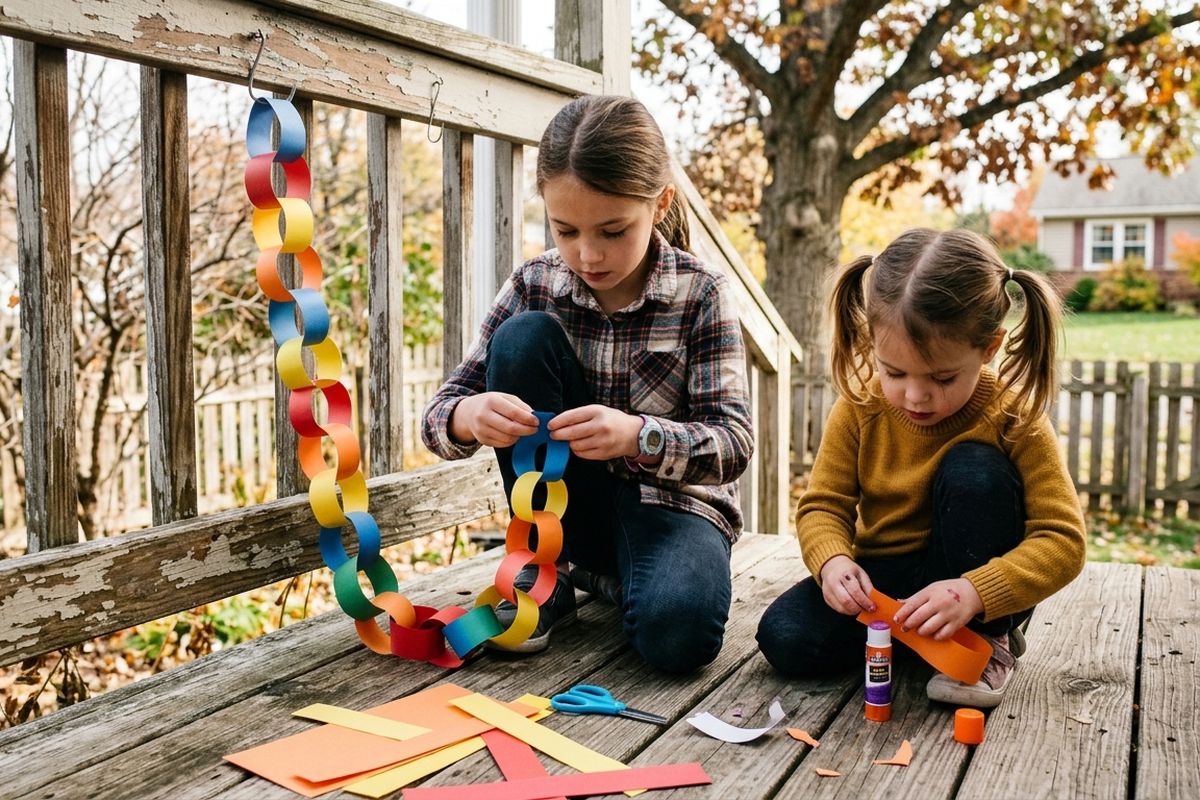
Counting down is the sleeps question, and it's the easy one, because the number shrinks. Six sleeps, five sleeps, four. An X per day makes the waiting visible. A paper chain does the same job if your household can tolerate small scraps of paper in every room. Mine can't, but perhaps you live cleaner.
Counting on is the hard one. "What day will it be in nine days?" is addition on a number line that wraps around at the end of every row, and adults badly underestimate it.
Here's the trick nobody tells you: use the week as a unit. "Today is Tuesday. In one week it's Tuesday again, that's seven days. Then two more, Wednesday and Thursday. So nine days from now is Thursday." The 7 does the heavy lifting, which is the same move as skip counting wearing a calendar hat.
Two mistakes cause almost all the wrong answers. Kids count today as day one when the question means after today. And they lose the thread when a row ends, their finger drops to the next line, the brain resets, and Thursday quietly disappears. Pointing fixes the second one. For the first, say the boring sentence out loud: "We're not counting today. We start with tomorrow."
"Next Tuesday" and other things adults say wrong
We're much less clear than we think. "Next Tuesday," said on a Monday, means tomorrow to one adult and eight days out to another, and both of them will defend their version like a contested parking ticket. Kids are standing in the middle of this trying to build a system.
"The weekend" might be Saturday and Sunday, or Friday night onward, or whenever the grown-ups stop opening laptops. "In a couple of weeks" means two weeks, or anything from ten days to a month, depending on the adult and whether the garage has been dealt with.
What helps is pointing at the square while you say the words, and adding the number. "Next Tuesday, the 21st, is the dentist." "This coming Friday, the 17th, is pajama day." The date pins the floating phrase to something solid. Without it, a kid has to decode adult language and count time simultaneously, which is a lot for a person currently wearing one sock inside out.
Use questions with real stakes. "When is the field trip?" gets attention. "How many days until winter break?" gets more. A worksheet box labeled Count the Days gets you a kid practicing what the page designer wanted, not time. Loose teeth also work beautifully, because "how long has that tooth been loose" has drama, and drama helps.
Time words worth teaching on purpose
A handful of words deserve direct attention, because adults use them constantly and assume kids absorb them from the air. They absorb some. Not all.
- before and after
- yesterday, today, tomorrow
- last and next
- daily, weekly, monthly
- this coming, and a week from
No lesson required. Small openings work better. The school newsletter says the concert is Thursday the 9th: read it out loud, point at the square. A birthday invitation says 2 to 4 on Saturday: it goes on the fridge, and you say "that's this coming Saturday." The dentist card says six months, so flip ahead and show the month even if your kid only half cares.
There's a smaller version of all this living on the clock. "In an hour," "after lunch," "before bedtime," a.m. and p.m. are the same kind of language at a different scale, and those phrases cause their own trouble around the same age.
One school note, quietly: calendar language turns up in word problems well before anyone teaches kids to reason through it. "The trip is in 3 weeks" looks simple until a seven-year-old has to turn it into 21 days and land on the right square. Point, count, say the date. Then do it again tomorrow.


