

A 2nd grader I know announced at dinner that 7 is "the mean one, because it has no partner." Honestly, fair. I will take that over a clean worksheet answer any day, because it means the kid is looking at how a number is built instead of just naming it.
Why these "baby" ideas keep coming back
Even and odd, doubles, halves. Kids usually meet all three somewhere between kindergarten and 2nd grade, which means most of us file them in the cute-math drawer along with counting bears and the calendar song.
Then 3rd grade shows up wearing boots.
Those same three ideas come back in multiplication, especially the 2s, 4s and 8s. They come back in fractions, the second a teacher says "half of." They come back in division, where the real question is usually whether something splits without leftovers. And they come back in mental math, the day your kid notices that double 25 is 50, so 25 + 26 has to be 51.
The kids who look fast at math are mostly not doing magic. They are leaning on this same small handful of patterns, over and over, for years. They know when a number can pair up. They know a double without counting. They can cut a number in half in their head and keep going.
Even and odd, the sock way
The simplest test for even and odd is the pairing test: can everybody find a partner?
Socks are perfect for this, and not the tidy folded ones belonging to someone with a calmer life. Dump the basket on the rug and say "pair them up." Every sock has a partner, the number is even. One sock sitting there alone looking personally offended, odd.
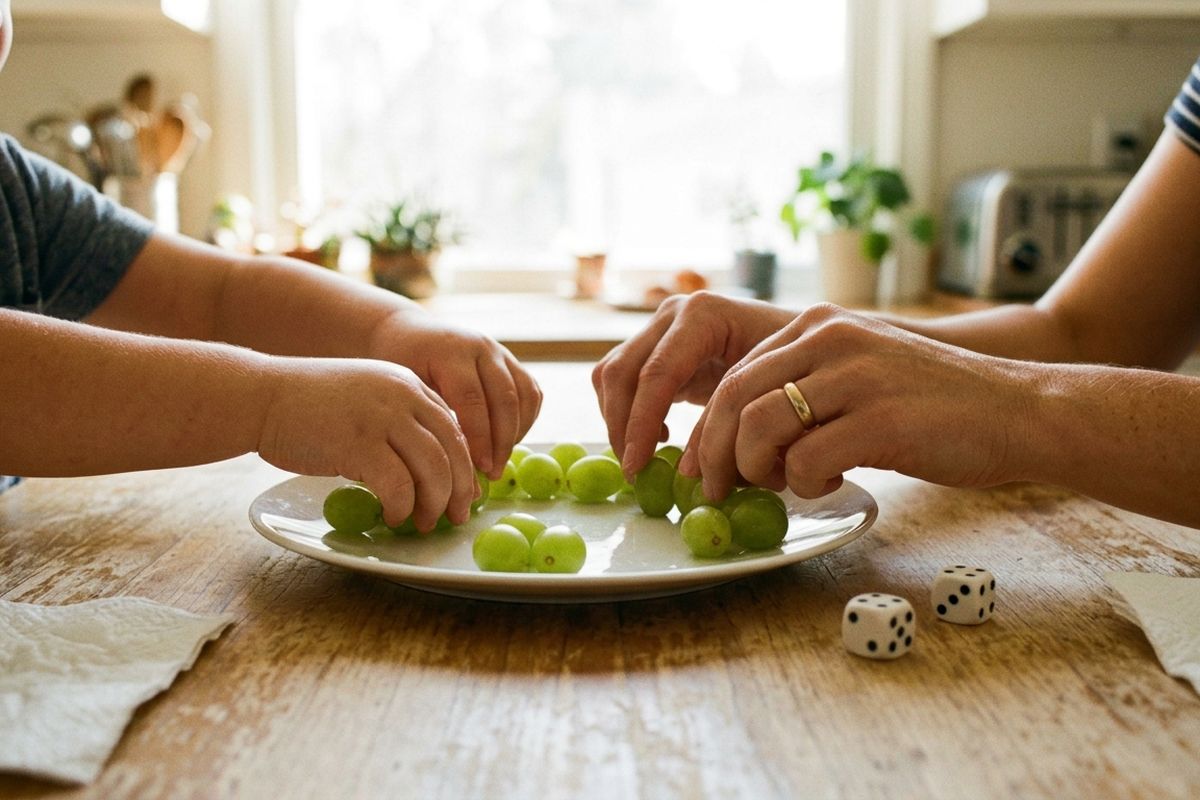
Then do it with 13 grapes. Six pairs and one leftover. Your child may eat the lonely grape; it helps morale.
After a few rounds kids start noticing the pattern on their own: numbers ending in 0, 2, 4, 6 or 8 are even, the rest are odd. That is also the trick that makes big numbers easy. You don't have to understand all of 4,782 to know it's even. You look at the last digit and you're done.
One predictable trap: kids will tell you 30 is odd, because "3 is odd." Reasonable mistake. Annoying, but reasonable. Point at the last digit. The zero is the one doing the job.
Doubles are the addition facts nobody brags about
Kids memorize 6 + 6, 7 + 7 and 8 + 8 as facts, and then nobody tells them what the facts are for.
Here's the trick nobody tells you: doubles are anchors. Once your child knows 6 + 6, then 6 + 7 is not a new problem, it's one more than a fact they already own. Same with 8 + 8 and 8 + 9. A kid who says "I know 8 + 8 is 16, so 8 + 9 is 17" is doing exactly the flexible thinking that addition and subtraction instruction is aiming at, and they're doing it two years early.
Doubles also slide straight into multiplication. Times 2 is doubling. The 4s are doubling again. The 8s are doubling once more after that. Take 7:
- 7 × 2 = 14
- 7 × 4 = 28
- 7 × 8 = 56
That is not three unrelated facts to cram. It's a staircase. My own 4th grader still doubles his way up to the 8s instead of recalling them cold, and that is fine by me. I would rather watch a kid get to 7 × 8 through 7 × 4 than watch him stare at the ceiling waiting for the fact fairy, who is unreliable and never shows up after dinner. If you want the order that makes the rest of the tables land, that's a separate conversation about which tables to teach when.
Halves: the first fraction, arriving in disguise
Half is usually the first fraction a kid actually understands, because it starts in real life. Half a cookie. Half a sandwich. Half the blanket on the couch, allegedly, though siblings have their own legal system for that one.
At first halving behaves. Half of 10 is 5, half of 12 is 6, two equal groups, everyone moves on. Then comes the useful crack in the wall: half of 9 is 4 and a half.
That moment does more work than it looks like it does. Fractions stop being a strange new planet and start being the answer to a question the kid already asked, which is what happens when it doesn't split evenly. A child who can see 9 crackers shared between two people as four each plus one cracker broken in half is already standing in the doorway of the fraction unit that shows up in 3rd and 4th grade.
Halving also takes the drama out of bigger multiplication. 16 × 5 sounds like a fact you either have or you don't. But 16 × 10 is 160, and half of 160 is 80. Same answer, no memorizing. That's kitchen-table math: useful, faintly sneaky, and much better than a page of tiny boxes.
Ten minutes that don't feel like practice
None of this needs a lesson. Ten minutes is plenty, and five is fine on a night when someone is already under the table for reasons unrelated to math.
In the car, ask whether that house number is even, or the last digit of the license plate in front of you. Keep it short. When your child answers, ask how they knew. If the answer is "because it ends in 8," you're finished, that was the whole lesson.
At the table, roll two dice and have them double one number. Rolled a 5, they say 10. A week later, make it a near double: what's 5 + 6? With a deck of cards, pull the face cards out, start with the even cards and ask for half, then let the odd ones back in and allow "3 and a half" as a real answer. Say it like it's a normal thing to say, because it is.
Five questions worth having in your pocket:
- "Can these pair up evenly?"
- "What's the double?"
- "What's one more than the double?"
- "What's half?"
- "How do you know?"
What I'd skip: the worksheet with 40 circles to sort into even and odd. I have strong feelings about those, mostly because they appear to be designed to make the child and the pencil give up at the same moment. Three good rounds at the table beat forty circles. And if the practice keeps ending in tears, park it and come back on a calmer day, or read up on keeping math practice from turning into a nightly standoff before you try again.


