

The October report card comes home and it doesn't match the kid you know. This is the one who coasted through 2nd and 3rd grade, finished the math page first, remembered Crazy Sock Day without being reminded. Now there's a C in one subject and a note that says "incomplete work," which is the school version of a smoke alarm chirping at 2 a.m.
Fourth grade does this to a lot of kids, and it does it quietly.
Fourth grade quietly changes the job
Through 3rd grade, school mostly rewards three things: decoding the words, computing the answer, following directions. Real skills, and your child had them.
In 4th grade the job description changes to thinking about what you read, explaining how you know, and managing your own materials without an adult standing two feet away.
Reading changes first. Kids move from stories with a beginning, middle and end into science and social studies text stuffed with headings, diagrams, captions, sidebars, bold words and vocabulary nobody uses over spaghetti. Erosion. Legislature. Adaptation. A child can read every word of that paragraph and have no idea what the paragraph did. The volume roughly doubles too, and nobody rings a bell to announce that your child now needs a system.
Math stops being one neat step at the same time. Multi-digit multiplication, long division, fractions, and word problems with the first question hiding inside the second one like a raccoon in the garage.
Then independence arrives all at once. Homework logged by the kid. A project with a due date two weeks out. In some schools, two or three teachers instead of one. The backpack becomes a filing system, which is funny if you've ever looked inside a nine-year-old's backpack.
Why a kid who was "good at school" gets hit hardest
The children who get walloped are usually the ones who looked fine before.
If yours read early, computed fast and remembered directions without effort, they may never have built a single study habit, because nothing required one. The work was short enough and familiar enough to carry around in their head. Then a six-page packet turns up with a vocabulary quiz next Friday.
The old tricks stop paying. Guessing from the picture doesn't do much when the picture is a labeled diagram of the water cycle. Memorizing the pattern is useless when the problem wants two operations and a sentence. Asking the teacher right away is harder when the teacher is across the room and the expectation is that you try first.
Meanwhile vocabulary and background knowledge start carrying the weight. A kid can decode "the delegates convened" flawlessly and take away nothing at all, which is the gap between reading the words and getting the meaning showing up in a harder book.
There's an emotional piece adults underestimate. At seven, a bad grade is a strange sticker. At nine or ten, kids compare out loud. They know who finished first, who got pulled to the back table, who said "that was easy." For a child whose whole identity has been "school is easy for me," the first real friction feels personal.
It isn't personal. It's a new job description. And it doesn't hit everyone in 4th grade either; some kids meet it in late 3rd, some in 5th, some barely notice.
What teachers see
From the school side this rarely looks like a collapse. It looks like small leaks.
Fine on the math facts, lost on the word problem. A kid who knows 8 × 6 cold and has no idea what to do with "Maya bought 6 packs with 8 pencils in each, then gave 17 away." The arithmetic isn't the problem. The deciding is.
Reads aloud beautifully, then goes blank at "what was that section mostly about?" Especially with nonfiction. The mouth did the reading; the brain is still parked back at the word "sediment."
Then the organization mess. Work completed and never turned in. A folder like paper lasagna. A permission slip at the bottom of the backpack with a granola bar wrapper and one sock. "I forgot I had it," says your child, and you believe them, because clearly.
Written answers get thin, too. One fast sentence where the question asked for three details, no evidence from the text, everything in the register of a text message to a cousin. "Because he was mad."
And avoidance dresses up as attitude. "This is boring." "I'll do it later." "I already know this." Eleven bathroom trips during independent work. Sometimes boring means boring. Often it means: I don't know how to start, and I'd rather be annoying than feel dumb. Steady beats alarmed here, which is most of what to do when a kid slips behind in one line.
What actually helps at home
The support that works is boring, and I mean that with affection.
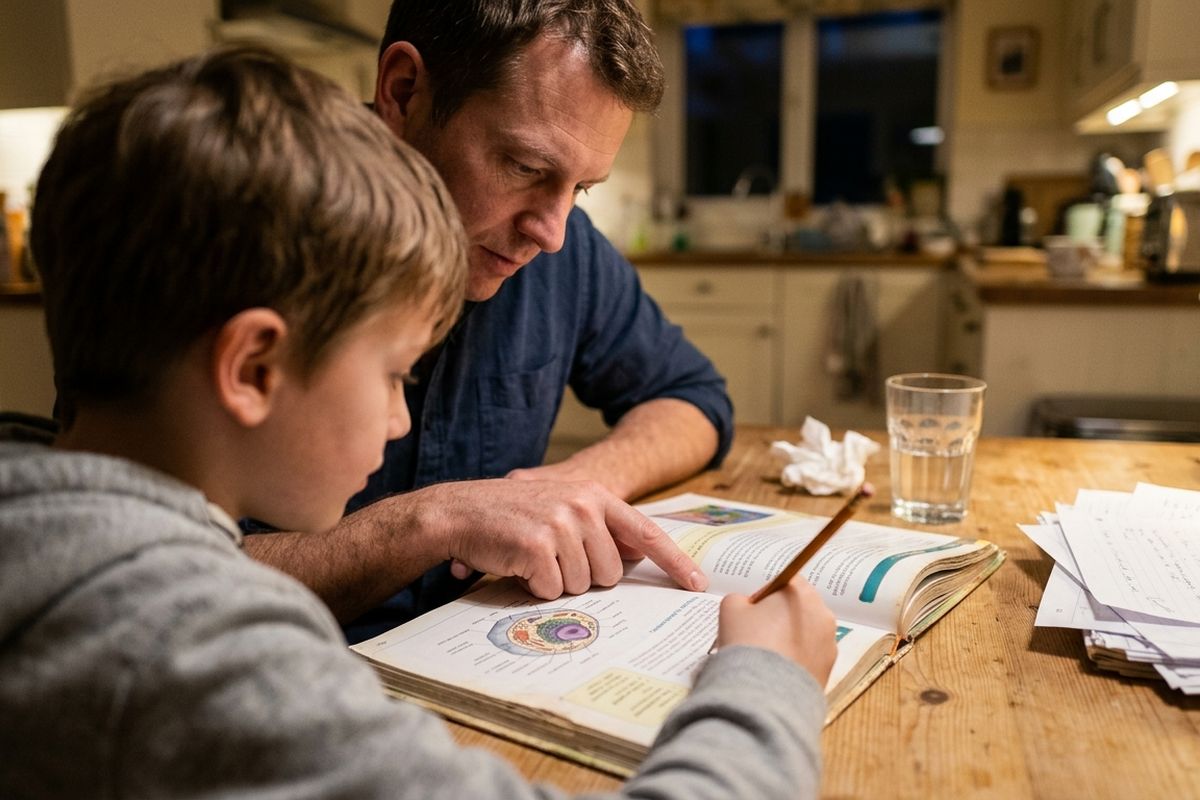
Start with the nonfiction. Sit next to your kid and read it out loud for ten minutes. Not an hour. Headings first, then the diagram, then the caption. After each chunk: "what was that part about, in one sentence?" That single habit outperforms another stack of practice pages, and I say that as someone who thinks a fair number of worksheets are paper pretending to be instruction.
For word problems, stop the grabby number hands. Before the pencil moves, your child says what the question is asking. Then they draw something. A bar, a box, six circles, a stick figure. With 48 muffins packed six to a box and three boxes sold, the useful sentence is "first I need how many boxes, then how many are left." The division is just a step in the middle, and most word-problem trouble lives in that first sentence, not in the arithmetic.
For organization, externalize everything. One folder. One place homework lives. A five-minute backpack check at the same time each evening, say 6:45, after dishes and before anyone starts negotiating about dessert. At nine, the system is the skill. That's not nagging, it's scaffolding.
Long assignments get broken into dated chunks on paper, once, together. Monday: pick the topic. Tuesday: three facts. Wednesday: rough paragraph. Then step back, because hovering for two weeks turns a school project into a family heirloom.
If math facts are shaky, ten minutes a few times a week is plenty. A kid still counting up from 7 to get 7 × 8 has nothing left over for long division.
What doesn't help: another workbook, an extra hour of homework, or re-teaching an entire unit at 8 p.m. while everybody cries onto the multiplication page. When evenings have turned into a standoff, tightening the routine beats adding volume, and the homework battle has its own fixes.
When it's more than the 4th grade jump
For most kids this settles inside a semester once the adults add small, steady supports. Not heroic ones. Not a color-coded command center that requires a laminator. Ten minutes of reading together, a folder routine, and math that starts with the question.
Email the teacher if it's showing up in every subject, if the work is fine at home and never arrives at school, if reading is genuinely slow and exhausting, or if your child says they're stupid.
That last one gets my attention fastest. A bad grade is a problem to solve. "I'm stupid" is a story a kid starts telling about themselves, and those stick if nobody interrupts them.
Keep the email to two questions: what does this look like in class, and what would you do first? Both beat the long theory you were going to send at 11:17 p.m. Ask me how I know.
One quiet line worth holding onto: reading that's still slow and effortful at this age, or attention that falls apart even on things your child enjoys, is worth mentioning to the teacher or your pediatrician instead of waiting it out. Not because something is wrong. Because guessing for another six months is a lousy plan.


